
 Expanding your business from India to the United States is a massive milestone. Whether you manufacture medical devices, food and beverages, or pharmaceuticals, the U.S. market offers incredible growth potential. However, navigating the US FDA registration process can feel like scaling a mountain of bureaucracy.
For Indian manufacturers and exporters, a single oversight can lead to customs holds, export delays, heavy fines, or legal penalties. At Filings India, we help businesses streamline their compliance so their shipments never miss a beat.
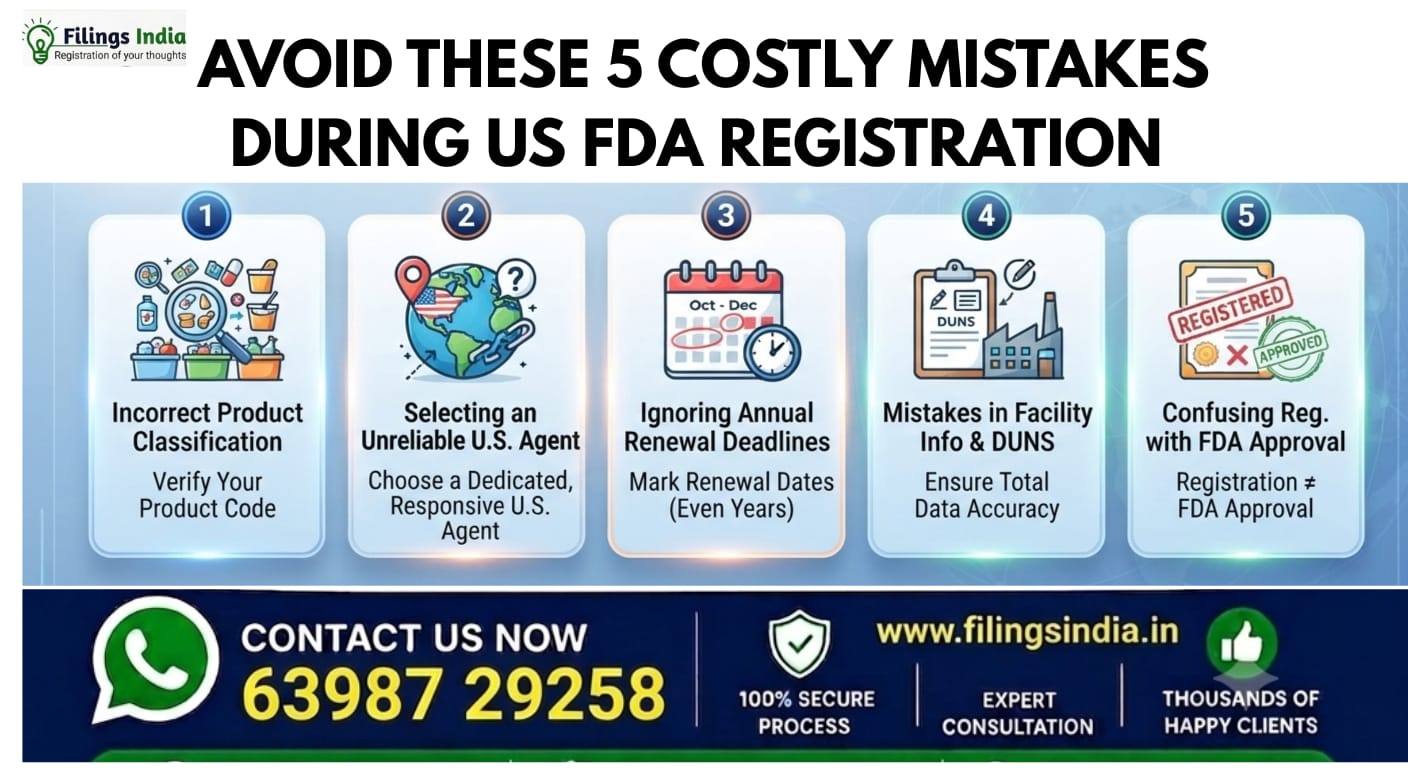
Below are the top 5 common mistakes Indian exporters make during US FDA registration—and how you can avoid them to keep your supply chain running smoothly.
1. Incorrect Product Classification
This mistake often happens before any paperwork even begins. The FDA categorizes products based on risk. For instance, a simple surgical mask might fall under Class I or II, while high-risk surgical or implantable devices require rigorous Pre-Market Notification (510k) clearances and different user fees.
- The Risk: Misclassifying your product means you might pay the wrong user fees or fail to submit necessary pre-market approvals.
- The Fix: Always verify your exact product code and classification in the FDA database before initiating registration.
2. Selecting an Unreliable U.S. Agent
As an India-based company, appointing a U.S. Agent is a strict legal requirement for your US FDA registration. This agent acts as your primary emergency contact point for the FDA.
- The Risk: Many Indian businesses make the mistake of assigning a distant relative or casual business associate who knows nothing about FDA regulations. If the FDA calls and gets no timely or adequate response, your registration can be revoked instantly, and your products will be impounded at U.S. Customs.
- The Fix: Choose a professional, knowledgeable U.S. agent or compliance partner who understands regulatory demands and maintains constant availability.
3. Ignoring Annual Renewal Deadlines
US FDA registration is not a “set-and-forget” task. For instance, food and beverage facilities must submit registration renewals during specific windows—typically between October 1st and December 31st of even-numbered years.
- The Risk: Missing these critical windows results in an expired registration status. U.S. law strictly forbids operating or importing with an expired registration.
- The Fix: Mark your calendar ahead of time and handle your annual renewals well before the deadline closes.
4. Discrepancies in Facility Info and DUNS Numbers
Details matter deeply to the FDA. Typos in your facility address or Data Universal Numbering System (DUNS) number can cause immediate registration failure.
- The Risk: If your US FDA registration profile does not identically match your shipping documents and product labels, customs officials will flag your shipment. Furthermore, if your factory relocates or changes ownership, failing to update the portal within 30 days can land you in hot water.
- The Fix: Ensure absolute consistency across all corporate documents, shipping papers, labels, and the FDA portal.
5. Confusing Registration with “FDA Approval”
One of the most dangerous myths in exporting is believing that a registration certificate means your product is “FDA-approved.”
- The Risk: Registration is simply a notification mechanism letting the FDA know your facility handles a specific product. It does not mean the FDA has evaluated your product’s safety or efficacy. Using misleading health claims on your packaging despite only being “registered” can trigger severe Warning Letters or Import Alerts.
- The Fix: Ensure your marketing and labeling strictly adhere to FDA guidelines without falsely claiming direct product endorsement.
Final Thoughts
When exporting to the U.S., precision is everything. Treating compliance as a continuous commitment to safety—rather than a mere paperwork hurdle—protects your brand reputation, prevents shipment rejections, and saves thousands of dollars in avoidable fees.
Frequently Asked Questions (FAQs)
1. Is US FDA Registration a one-time thing?
No. Most establishments, particularly in the food and medical device industries, must periodically renew their registration. For example, food facilities must renew every even-numbered year between October 1st and December 31st. Missing this window causes your registration to expire and your shipments to be held at the port.
2. Does “FDA Registered” mean my product is “FDA Approved”?
No. US FDA Registration simply means your facility and product categories are registered with the agency. It does not mean the FDA has evaluated or “approved” your product. True “approval” is an intensive, case-by-case evaluation reserved for select items like new pharmaceuticals or high-risk medical devices.
3. Who needs a U.S. Agent, and what do they do?
Any foreign entity outside the U.S. involved in manufacturing, processing, or packing products destined for the U.S. must have a U.S. Agent located within the United States. They serve as the official emergency and communication bridge between the foreign entity and the U.S. FDA.
4. What is a DUNS number, and do I need one?
Yes. The FDA requires facilities involved with drugs and medical devices to have a unique nine-digit DUNS (Data Universal Numbering System) number. It allows the FDA to verify your facility’s physical location and current contact details.
5. What happens if I export without a valid US FDA Registration?
U.S. Customs and Border Protection (CBP) can detain your goods at the port of entry. You may face heavy charges for return shipping or destruction of goods, alongside potential legal actions that permanently bar your products from the U.S. market.
Ready to expand your business safely into the U.S.? For expert guidance on US FDA Registration, documentation, and compliance, feel free to talk to our business advisors at Filings India at 6398729258.
FILINGS INDIA SERVICES
ISO 9001 2015 | ISO 14001 EMS | ISO 22000 FSMS | ISO 27001 ISMS | ISO 50001 Energy Management | ISO 45001 | ISO Surveillance | ISO 37001 | ISO 20000 |CE MARKING |TENDER PORTAL REGISTRATION |TENDER DOCUMENT |ISO Certification | MSME Registration| Private Limited Company | Public Limited Company | One Person Company |Limited Liability Partnership | Partnership Firm | Sole Proprietorship Firm | Section 8 Company Registration | | Import Export Code | IEC Modification | AD Code Registration |Spice Board Registration | US FDA Certification | FSSAI Registration | Shop Establishment Registration | Barcode Registration | Coffee Board Registration | Startup India Certificate |ZED Certification | Trademark | Trademark Objection Reply | Trademark Opposition | Trademark Hearing | Trademark Formality Check Fail | Website Development | Patent |Copyright | Design Registration | Business Name Suggestion | Logo Designing | Trademark Assignment Service | GST Registration | GST Modification | GST Cancellation |GST Return Filing | UIN Registration | Income Tax Return | Income Tax Notice | Income Tax Refund | Income Tax Assessment | TDS Return Filing | Form 15CA / CB | Professional Tax Registration | 12A and 80G Registration | Bookkeeping & Accounting | Private limited Company Annual Compliance | Form INC-22A | Form 15CA / CB |Company Strike Off | Commencement of Business | Fssai annual return | Online CA Consultancy | Income Tax Return Filling | LLP Annual Compliances | Form DIR-3 KYC |Virtual Office for Company Registration |
External links :
FILINGS INDIA ON FACEBOOK
FILINGS INDIA ON INSTAGRAM
FILINGS INDIA ON YOUTUBE
FILINGS INDIA ON WATSAPP
