

The Gold Standard: Why ISO Certification is the Backbone of Modern Healthcare
In an industry where a single error can have life-altering consequences, “quality” isn’t just a buzzword—it’s a prerequisite. The healthcare sector—comprising hospitals, pharmaceutical giants, diagnostic labs, and medical device manufacturers—operates under a microscopic level of scrutiny.
To bridge the gap between operational effort and global credibility, the International Organization for Standardization (ISO) provides a robust framework of certifications. Here’s how these global benchmarks are transforming the healthcare landscape.
Building a Culture of Trust and Precision
The primary goal of any healthcare institution is the safety and well-being of its patients. However, demonstrating that commitment to the market requires more than just high-end equipment.
ISO Certification for the Healthcare Industry serves as a “Seal of Excellence.” Whether you are a drug manufacturer ensuring chemical purity or a hospital managing sensitive patient data, these standards prove that your processes are audited, consistent, and world-class.
The Strategic Benefits of ISO in Healthcare
1. Unmatched Quality Assurance & Patient Safety
ISO standards, such as ISO 9001, enforce a process-oriented approach. This reduces the margin for human error, ensures clinical protocols are followed strictly, and guarantees that the products—from bandages to pacemakers—are safe for human use.
2. A Powerful Boost to Market Reputation
In a competitive D2C and B2B market, credibility is currency. ISO certification acts as a powerful marketing tool that:
- Builds immediate trust with patients and stakeholders.
- Provides a competitive edge when winning government and private tenders.
- Facilitates global trade by aligning with international medical regulations.
3. Seamless Regulatory Compliance
Healthcare laws are complex and ever-changing. ISO frameworks are designed to keep your organization compliant with local and international statutory requirements, reducing the risk of legal penalties and ensuring your license to operate remains undisputed.
4. Operational Efficiency & Financial Growth
Efficiency leads to profitability. By identifying bottlenecks and reducing resource wastage, ISO-certified organizations often see:
- Cost Savings: Lower operational overheads and reduced insurance premiums due to lower risk profiles.
- Continual Improvement: A system that evolves based on feedback and data-driven audits.
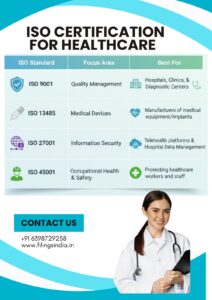
| Industry Segment | Recommended ISO Standard | Core Focus |
| Hospitals & Clinics | ISO 9001:2015 | Quality Management & Patient Satisfaction |
| Medical Device Makers | ISO 13485 | Safety & Efficacy of Medical Equipment |
| Diagnostic Labs | ISO 15189 | Competence in Medical Laboratories |
| Telehealth & IT | ISO 27001 | Protection of Sensitive Patient Data |
| Pharma & Manufacturing | ISO 45001 / 14001 | Worker Safety & Environmental Compliance |
Essential ISO Standards for the Healthcare Ecosystem
ISO 9001: Excellence in Quality Management (QMS)
Implementing the ISO 9001 standard allows healthcare providers to build a foolproof Quality Management System. By conducting regular internal audits and management reviews, organizations can proactively identify system gaps and apply corrective actions. This focus on risk management and continual improvement ensures that your services evolve alongside rapidly changing market demands.
ISO 14001: Sustainable & Eco-Friendly Healthcare
The ISO 14001 standard facilitates a robust Environmental Management System (EMS), crucial for reducing the ecological footprint of medical facilities. By optimizing waste disposal and ensuring strict compliance with environmental laws, healthcare brands can earn a reputation as “Green Organizations,” appealing to the modern, eco-conscious patient.
ISO 45001: Prioritizing Staff Safety & Workplace Health
The backbone of any hospital is its medical staff. ISO 45001 certification is the global benchmark for Occupational Health and Safety. It empowers institutions to identify clinical and workplace hazards early, implementing preventative measures that protect frontline workers from injuries and burnout.
ISO 27001: Ironclad Patient Data Security
As custodians of sensitive personal information, healthcare providers are prime targets for cyber threats. ISO 27001 (Information Security Management System) provides a high-level framework to safeguard patient privacy. This certification ensures that medical records and digital health data are protected against breaches, unauthorized access, or accidental loss.
ISO 13485: The Gold Standard for Medical Devices
For manufacturers of external or implantable medical equipment, ISO 13485 is non-negotiable. Because these products directly impact human life, this standard mandates rigorous quality controls. It guarantees that every device produced meets international safety benchmarks and maintains premium quality throughout its lifecycle.
ISO 50001: Energy Efficiency & Operational Savings
Healthcare facilities are energy-intensive operations. By adopting the ISO 50001 Energy Management System, companies can significantly lower their carbon footprint and operational expenses. It improves overall efficiency, allowing providers to reinvest those energy savings back into patient care.
Frequently Asked Questions (FAQs)
1. Is ISO certification mandatory for hospitals in India?
While not always mandatory by law for all clinics, ISO certification (especially ISO 9001) is often required for NABH accreditation, government tenders, and empanelment with major insurance providers. It acts as a primary document to prove operational quality.
2. How long does it take to get ISO 13485 for medical devices?
The timeline for ISO 13485 depending on the complexity of your manufacturing process and current documentation. At Filings India, we streamline this process to ensure you get certified as quickly and efficiently as possible.
3. What is the difference between ISO 9001 and ISO 13485 in healthcare?
ISO 9001 is a general Quality Management System applicable to service providers like hospitals. ISO 13485 is a specialized standard strictly for the medical device industry, focusing on safety, risk management, and regulatory requirements for hardware and equipment.
4. Can a small healthcare clinic apply for ISO 27001?
Yes. In the age of digital prescriptions and telehealth, even small clinics handle sensitive patient data. ISO 27001 helps clinics of all sizes prevent data breaches and build trust with patients regarding their privacy.
5. What is the validity of an ISO certificate?
Most ISO certificates are valid for 3 years. However, to maintain the certificate, the organization must undergo an annual surveillance audit to ensure the standards are still being followed correctly.
FDA
ISO CERTIFICATION | TRADEMARK REGISTRATION | IMPORT EXPORT LICENCE | TENDER PORTAL REGISTRATION | FSSAI Registration | Startup India Certificate | Udyam Registration | Copyright | PATENT | Trademark Hearing | Trademark Objection Reply | Trademark Opposition ISO 9001 QMS | ISO 14001 EMS ISO 22000 FSMS | ISO 27001 ISMS | ISO 45001 OHSAS | ISO 50001 Energy Management | COMPANY FORMATION
External links :
FILINGS INDIA ON FACEBOOK
FILINGS INDIA ON INSTAGRAM
FILINGS INDIA ON YOUTUBE
FILINGS INDIA ON WATSAPP
